

Who Is Watching Whom? Inside Issy Knowles’ Confrontational Solo Show, Body Count
Issy Knowles by Geve Penn

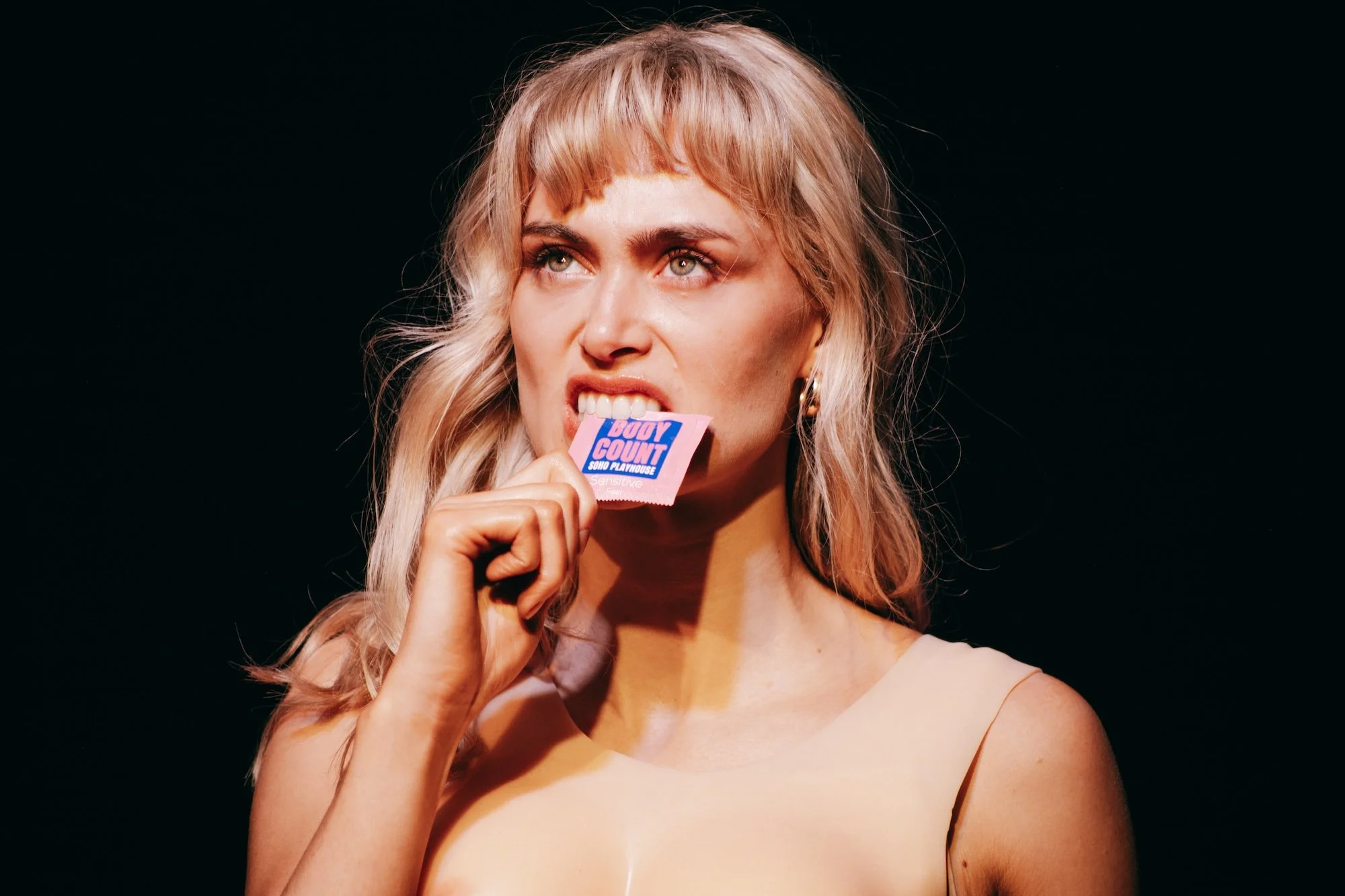
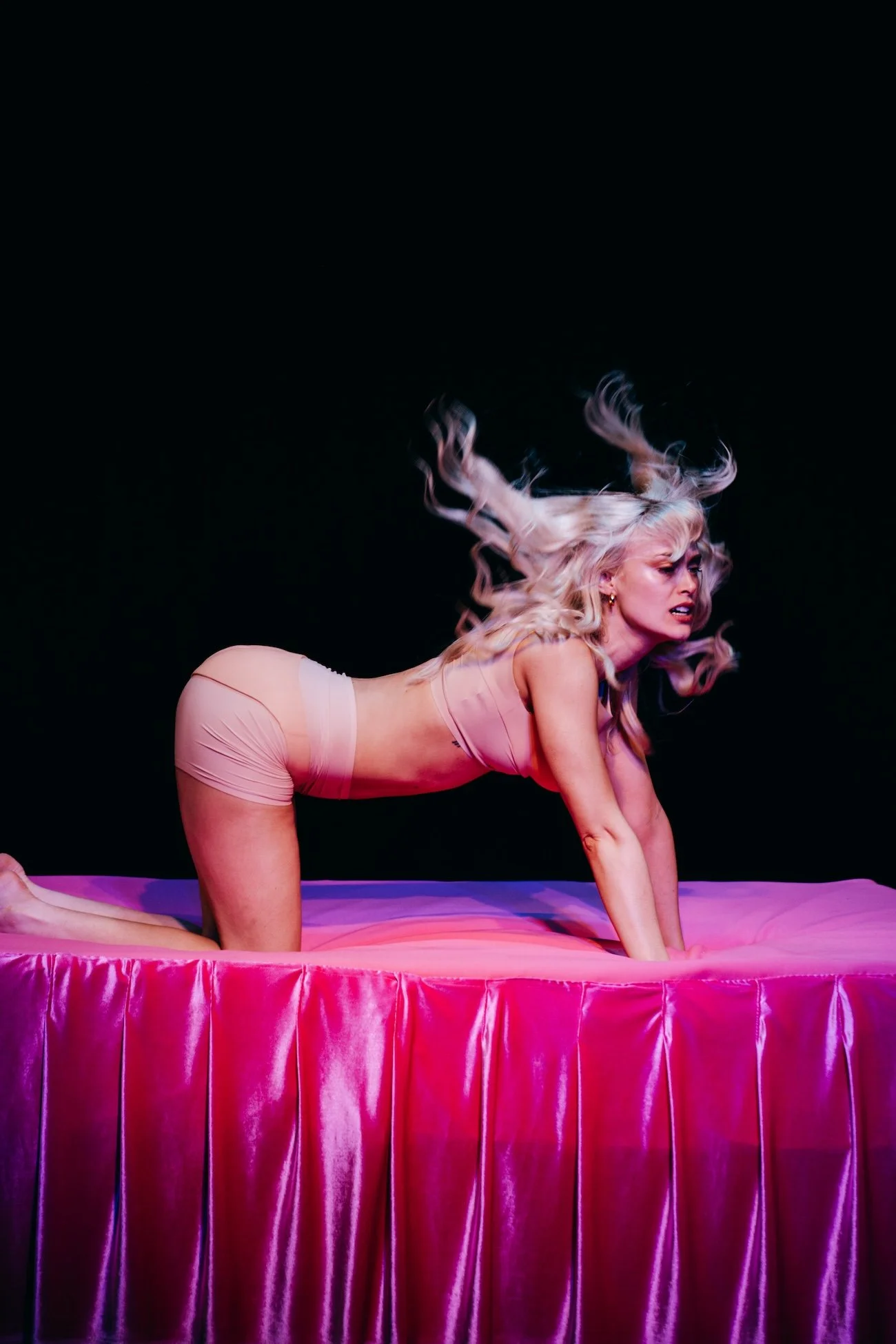
In its first rendition, Issy Knowles’ one-woman show Body Count began with Knowles tearing off her robe, turning around, and revealing her prosthetic vagina to audiences. The show debuted at Edinburgh’s Fringe Fest in 2025 and, despite opening to good reviews, Knowles describes audiences as “somewhat repulsed”. The crowd, she recounted, physically leaned back as Pollie, the OnlyFans model, marched through her conquest to sleep with 1,000 men in a single evening.
Knowles developed an obsession with content creators like Bonnie Blue and Lily Phillips, who gamified their sex work into extreme challenges. The woman went viral for their sexual stunts; both claim to have slept with over 1000 subscribers in the span of 12 hours. Knowles wrote about the phenomenon. She was interested in the fantasy these women sold about how all the men who participated were perfect and lovely, which sharply contrasted with the men she knew in real life. She was also troubled by how much the general populace shouldered the blame to these polarizing figures.
“I write when I’m angry,” said Knowles. “I inherently empathize with these women. I share a kinship with them in terms of knowing what it feels like to have been raised to please men.”
Between the ages of 15 and 20, before she was a writer, Knowles was a model. Her experience left her so traumatized and outraged that she produced a documentary entitled Model Behaviour. Before the documentary could be released, she received an anonymous email threatening the release of the film. Though the material found light in the form of an eponymous one-woman show, she felt like she had once again been silenced.
Through the fictional Pollie, Knowles portrays a woman with a fairly average upbringing, marked by a turbulent relationship with men and God. The character’s backstory largely draws on Knowles’ own biography. The writer knew she wanted to avoid filling in the blanks of someone else’s story. She was also careful to avoid an inciting trauma that catalyzed Pollie’s turn to sex work.
“I think we live in a society in which men are encouraged to sleep with as many women as possible, and women are encouraged to safeguard their bodies,” Knowles explained. “I think we live in a society that creates disconnection anyway.”
During her Edinburgh run, Knowles couldn’t shake Pollie between shows. The month led to her own points of disconnection and many mornings with performance hangovers. Audiences’ discomfort made performing exhausting.
In the interim between Edinburgh and Body Counts’ extended run at The Soho Playhouse, Knowles completely reworked the show with the help of her director and trusted collaborator, Alice Wordsworth. The role of God shifted from a benevolent voice (meant to highlight the contradictions of judgmental Christians) to the harsh, omnipotent God of Knowles’ childhood.
“It was men who approached her afterward to have in-depth conversations about Pollie and the politics surrounding her.”
Wordsworth and Knowles eventually developed a system to sharpen the divide between the character and Knowles’ real life. Wordsworth, who served as the assistant director on the West End’s rendition of A Little Life, was well-versed in helping actors separate themselves from challenging, potentially traumatizing roles. They renamed the plastic breasts and vagina “Pollie” and bid the character goodnight after the performance. Knowles even got in the habit of tucking the costume into bed in the evenings. Eventually, the performance hangovers went away.
The writer and director also made a challenging choice to remove a violent scene toward the end of the production. According to Knowles, Wordsworth levied a concern about portraying violence against women on stage. The scene, which depicted a gang-bang, was viscerally disturbing. Knowles agreed with Wordsworth’s conclusion, but also wondered if it was an important confrontation, especially for the men in the audience.
“A lot of men will regularly consume porn, potentially quite violent porn, without ever stopping to think about the performers within it,” Knowles commented. “I think there's something very brutal in getting to know a character, and then watching that same person be put in a very dehumanizing situation.”
Issy Knowles by Geve Penn
Body Count evokes questions of complicity. Before the lights dim, each audience member is given a blue hood, meant to mimic the anonymous subscribers standing in a line 1,000 men deep. Early on, Knowles noticed that women tend to remove their hoods, while the men remained masked for the duration of the 55-minute show. Despite the heat and general discomfort of the prop, Knowles wondered if there was a certain safety in remaining masked.
While women felt seen by the show, men had more emphatic reactions. Knowles received DMs detailing men’s fraught relationship to porn, thanking her for making the show. It was men who approached her afterward to have in-depth conversations about Pollie and the politics surrounding her. Even close male friends and family shared intense, slightly “traumatized” reactions, according to Knowles. By accident, Knowles had created a show for men.
In Body Count’s final scene, Knowles sheds prosthetic Pollie. She had always known she wanted to take her final bows sans “pussy pal”. Much like Pollie’s persona, the naked suit was over the top, a garish twist on a male centered fantasy. When she was conceptualizing the show, Knowles came to her conclusion via an image she saw on Facebook. Raoof Haghighi’s illustration, Just take them and leave me alone!.
“I suddenly realized that it's just those two body parts that make me vulnerable when I walk home alone, when I'm drunk at a festival or a club or sober, in a space with a man and feeling afraid,” explained Knowles. “If we could reduce ourselves down to our body parts, would it make us safer?”